The Texture of Civilization
written on June 26, 2026
The Donauinsel, Vienna’s Danube Island is a long artificial island, a piece of flood protection that also became a place for recreation. People bike there, swim there, walk there, have a drink there. If you live in Vienna for long enough, you probably think you know it.
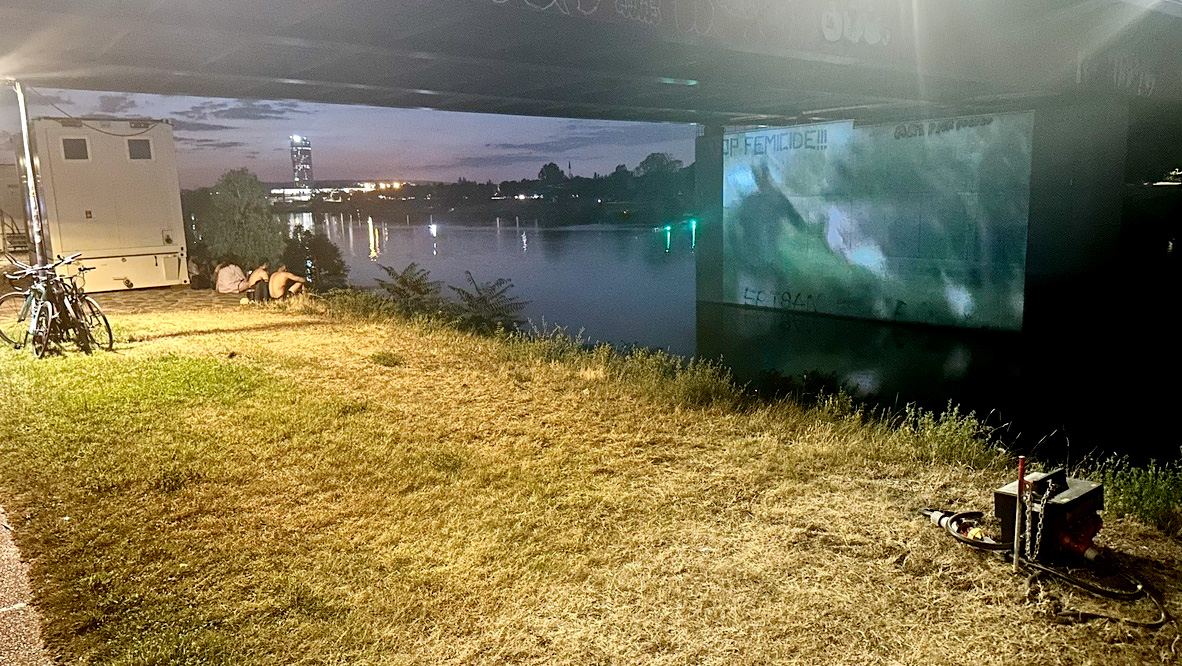
But then go there by bike at night and cycle slowly the entire length of it, with the intent to absorb and look, and suddenly the island is not one place but many. There are families, immigrant communities and friends sharing food and drinks. There are groups doing sports, people dancing, teenagers meeting friends, people making music, people watching a movie projected onto bridge pillars, fishers patiently waiting, people who clearly know exactly where to be and when. Many of them are not there by accident or spontaneously as they come back weekly because they have rhythms and rituals. Some of the island’s life is private, messy, a little sketchy, or simply not meant for you — also a feature of public spaces that allow some amount of privacy in the dark.
The first temptation is to feel like you discovered something. But that quite right. Even if you cycle there regularly, even if you start recognizing the same groups in the same places, you remain an observer to other people’s experiences. You mostly discovered that there is something you do not know.
To me, passing by on a bicycle, you recognize the same people in the same spot, but for them it is a dense social experience. They know who comes every week, who has not been around for a while, who is new, each other children’ school results. They know the detail from the inside.
And so, cycling through the night on an island allows you to become a little visitor to other people’s experiences and the presence of those experiences makes that ride so much more enjoyable.
John Salvatier once wrote that reality has a surprising amount of detail. One example he gives is a staircase. Stairs sound simple until you actually try to build one, at which point every board, screw, angle, tool and material defect becomes a small dickering with the physical world.
The realization that there are details everywhere does not just matter for engineering, but also to the observations you can make on groups in public spaces. The hidden detail is not in boards or screws, but in habits, relationships and repeated uses of a place. You can pass through it, be lifted by it, and still not know it from the inside.
A public space is not valuable merely because a number of bodies can be counted inside it. It is valuable because it allows rich details to accumulate and to leave a lasting imprint. But that requires infrastructure in more than one sense.
Some of that infrastructure is formal. There can be paths, bridges, lights, bathrooms, and playgrounds. The danube island itself is this kind of infrastructure. It lends itself to being used in ways that were not all intended when it was made. That formal infrastructure gives birth to the informal and quite ephermal one: a speaker on a tree, a movie on a bridge pillar, markings in a bench, a spot everyone knows is used for dance practice, a grind box built by a community in a hidden spot. It is where people take the formal room they were given and make it specific.
Modern societies don’t value that nearly enough. Vienna is not particularly good at making room for this kind of life, which is why losses of such spaces hurt. There used to be a great skate park, entirely built by the community that used it on temporary grounds, and it was eventually razed when the city reclaimed the space. Cities have constraints and every unallocated plot will eventually want to turn into a project. But something real disappeared there. It was someone’s unpaid labor and imagination becoming part of the world which then became a gift to others who could enjoy without knowing who made it.
Fear can also harm the existence of such spaces. The danube island and ajacent spaces are routinely pulled into political discussions because that space is also occupied by immigrant communities or enables illicit transactions. Community maintained playgrounds have to fight a constant struggle with overzealous individuals who want more safety.
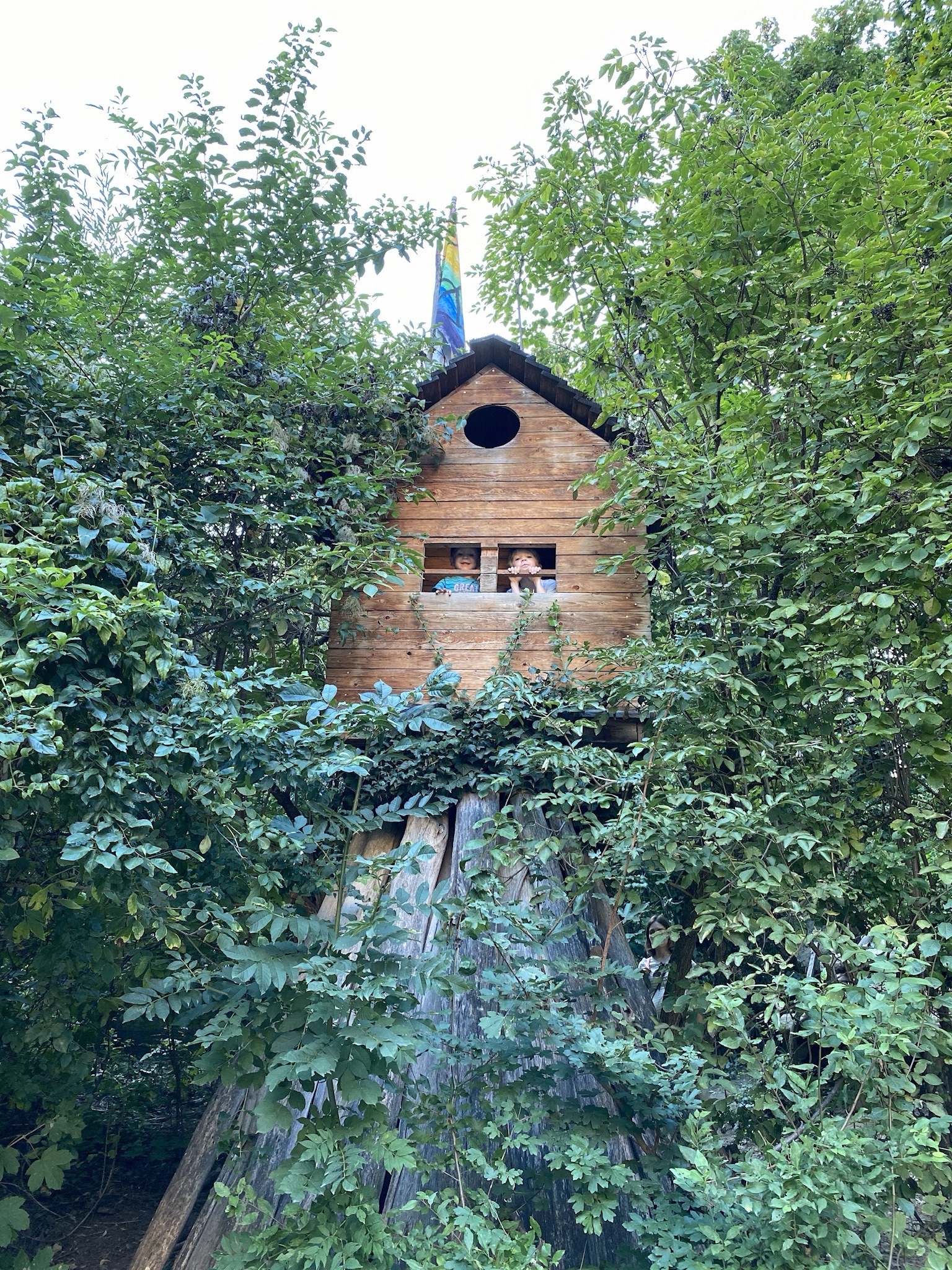
Formal infrastructure without informal life is sterile and boring and all this informal life needs formal places not to fizzle away. Formal infrastructure without space informal life is also inefficient. So many great spaces in cities lay dormant.
Frustratingly, much of the present moment appears to be discussed in very low resolution: money, control, competition, geopolitics. Europe is painted as being in a permanent state of decline and loss of GDP, and sure, one would be a fool not to pay attention to its struggles. Yet it is a very thin description of what society is for. Most importantly these public spaces are open to everybody, regardless of income. They can act as a great equalizer that brings people together, that would otherwise not meet.
If you accept the idea of the world being defined by money and power only, even if you only care about building companies, increasing output, winning the future, the question really will be for you too: to what end?
A civilization can build offices, data centers, airports and 24-hour coffee places for engineers to continue working late at night and to increase efficiencies. It can optimize the calendar until every hour is dedicated to the creation of shareholder value. It can produce more and measure more and still lose the texture that made any of it worth doing. The activities of people that takes places on informal places like the island will not show up in metrics. The shared meal, the outdoor dance class, the circle of friends that meets in the same spot every Thursday, the child who grows up associating a piece of public infrastructure with summer evenings and family are not accounted for either. And yet they are part of the reason to have an economy in the first place.
This is not an argument against work or ambition. It is maybe an attempt to remind both myself and others that we should not lose sight of how much detail is in this world, and how much these things also matter. Prosperity should buy us more than more work even if we find work fulfilling. It should buy room for human worlds to become detailed and it should encourage us to create the spaces for others to fill. Otherwise, who wants to win the future and then live in a civilization emptied of its human texture?