The Golden Age
written on October 31, 2026
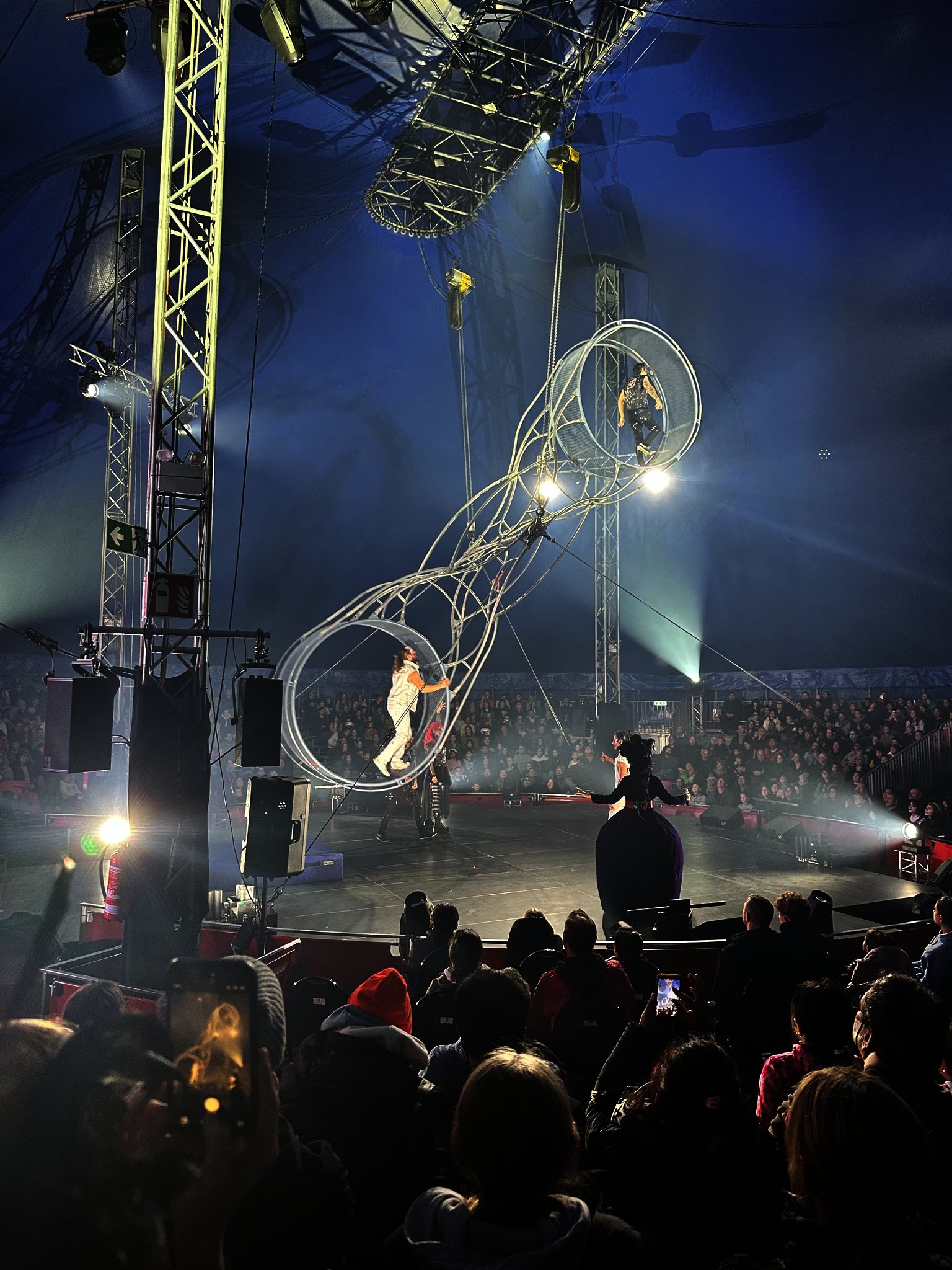
This Halloween weekend we went to watch the brief Halloween circus show at Family Park — a family tradition. It’s just 45 minutes, but there are some pretty impressive performers and their life is to show the unexpected, something that the average human is not capable of doing. As silly as such traditions are, they give one a sense of normalcy in the world. But this world is very much not normal.
My kids are growing up in a world of war. We’re lucky that we’re not directly affected, but some of their friends escaped one. Many of our friends had to leave their country of origin because of political instability and war. Many of them are lucky in that they have the means and opportunities to start a new life in a new place. And well, my kids grow up in a country without a real army, but with mandatory conscription.
But all our lives are being affected by a society and world that is changing around us in ways that can be frightening. It’s not just hot wars, it’s also a world of increased hostility expressed in everyday conversations. It’s a world that increasingly no longer wants the rule of law. Our social systems are increasingly no longer going to be working, and the economic developments are greatly uneven in the world. Blocs like Europe which were built on the idea of peace and stability are finding it hard to adjust to a world that wants none of that.
It’s not very hard to only look at the great opportunities if you live in Silicon Valley. There, you are far from war (there isn’t even a draft). Which is ironic, given that the US did in fact start a war. But it’s one that barely touches its tech elite. There you’re at the center of innovation and you’re living in a country rich with resources, and the general sense is that one will be largely unaffected by climate change — even though that is probably wrong. But even if climate change were to affect the US negatively, money does a lot to shield you from it. Living in a country which only ever fights wars abroad and a country which can force any country into submission can make one believe a thing about the world that does not reflect reality much. And even the self-inflicted Iran war is doing much more damage abroad than in the US.
I might not live in the valley, but mentally I am. My career and my social circles are there and so is my mind. I’m in that bizarre sphere where I both appreciate and love the US and the tech industry, but I also cannot help but see the damage we inflict on the world.
From Vienna to Lviv in Ukraine it’s not much further than to Bregenz, a city in Austria. Every day you can see trains going from Vienna to war-torn Ukraine. A country that has lost almost half its population with cities in rubble.
The everyday European citizens are seeing their pension systems crumble and their everyday prices go up, caused by wars and conflicts they have nothing to do with. We now have 65 active conflicts in the world and many of these conflicts have no obvious way out. You can’t make it a day in the news without people (sometimes violently) demonstrating against the changes that are happening to their lives.
That is the backdrop for this ongoing AI revolution. For those in the valley who are at the center “We’re in humanity’s golden age.” It’s a golden age that should be there for all — except you shouldn’t own it, because as Sam Altman says: owning it would be a bad allocation of resources.
It’s pretty clear that this AI revolution is not felt by many, and probably even more don’t see the upsides. It should not surprise us that those of us with the means and power cannot get others to see that. People who don’t have any say or control in this newfound revolution do not trust the industry and have little belief that what is unfolding will be good for them. And for good reason. The industrial revolution might have been great for humanity, but for many of the workers in that revolution life did not feel great. Much of human innovation resulted in bad health outcomes, and modern worker rights were a direct result of horrific exploitation.
We might think of ourselves as a society that moved past these things, but it’s no surprise that worker rights will be the first thing that will go, in an effort to rejuvenate a broken economy and to stay competitive. Citizens stuck in lower paid jobs will suffer quickly, when the ones with money and power will not.
“You got to embrace this future” is easy to say for someone who lives a post-economic lifestyle who exerts so much power and influence that almost nothing can harm them. Very little in our lives would change as a result of diesel going up a few cents. Or people dying in senseless wars. Because money does not just buy you enormous flexibility, it also keeps you secure. For many of us, whatever the outcome of AI might be for our lives, we will be fine. Not just fine, we’re pretty much guaranteed to be better off. But I have significant doubts that this will extend to society as a whole.
I too think that it’s inevitable that companies will be required to run on AI. That software engineering without agents can no longer work. But simultaneously so far we have surprisingly little to show for most people, other than the new kind of tax we pay for it. The tax to keep our data secure, the tax we pay for the increased cost in hardware. More and more of society will live in a world where a percentage of their expected increases in salary will instead go to fund hyperscalers and the tokens they need to do their work.
Clearly a lot of the economy will change as a result of AI but not all of it. The circus performer’s reason to exist is not changing because AI creates great robotic circus performers. What makes them worth watching is that they bend what a human body and mind can do and no artificial contraption is going to give you that same feeling. And if there is a measure to judge if we are in a Golden Age or not, it should probably be something like that: what it allows people to do, and not what it allows a few to own and control.
But maybe Guillermo is right and in some ways this is a “Golden Age”. But a golden age like the Dutch Golden Age: it overlapped with the Eighty Years’ War and much of what made it a golden age was financed through colonial violence and slave trade by the East and West India companies. The name only came about in the 19th century, given by people who looked back at those who got to enjoy it. A term that the Amsterdam Museum stopped using in 2019 as a recognition of all the people for whom that century was anything but golden.